Design Document
1. Introduction
1.1 Purpose
This document outlines the backend design for the “Tutor Times” and assessment analytics feature in OnTrack. It defines the architecture, schema, and API-level implementation details to support real-time tracking and management of tutor marking sessions across units and tasks.
1.2 Scope
This design covers:
- Data Models and Schema (updated to support real-time analytics)
- RESTful API Endpoints
- Real-Time Tracking Integration
- Authentication and Authorization
- Session Lifecycle and Timeout Logic
- Data Aggregation and Integrity Constraints
- Performance Optimization
- Security
- Compatibility with Frontend and Related Modules
1.3 Intended Audience
This document is for backend developers, technical leads, and other stakeholders involved in implementing and maintaining the Tutor Times and Assessment Analytics features.
2. Architecture and Data Models
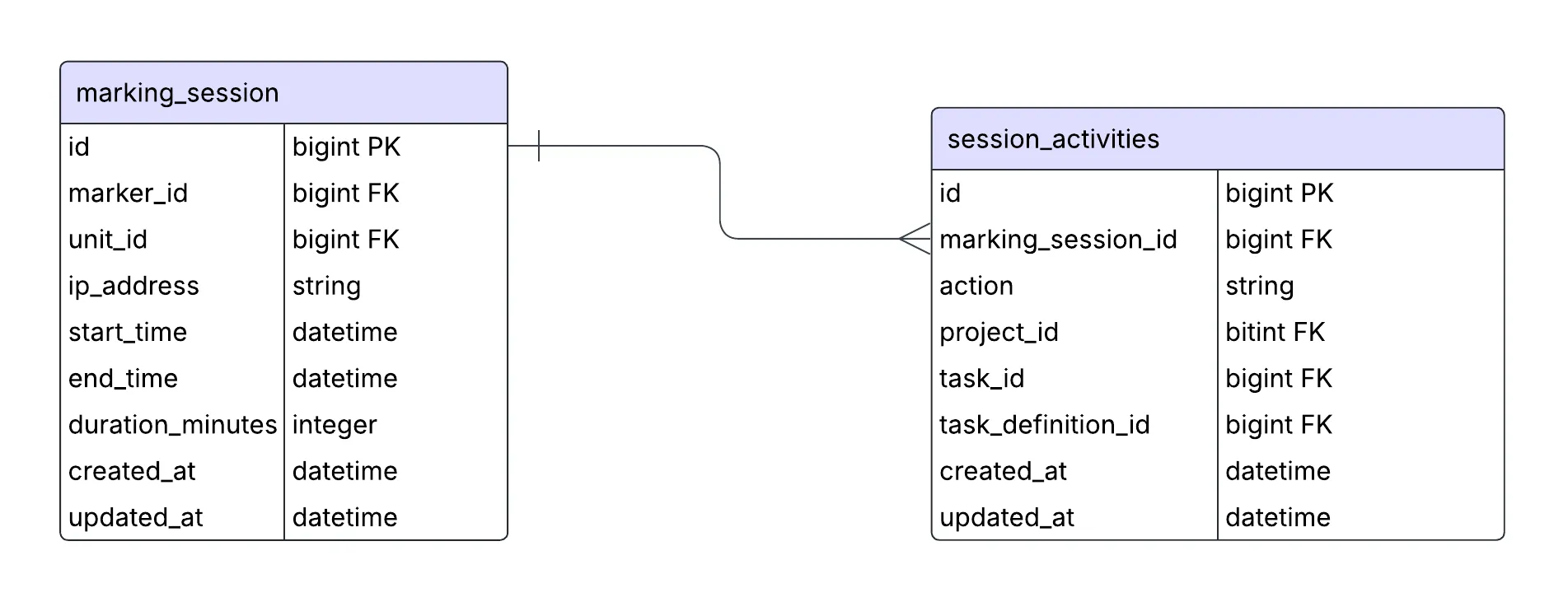
2.1 Data Storage
- Introduce new tables:
marking_sessions– captures marking periods tied to tutors and units.session_activities– logs discrete user interactions like task assessments.
2.2 Schema Definition
marking_sessions Table
| Column | Type | Notes |
|---|---|---|
id | bigint | Primary key |
marker_id | bigint | FK to users, tutor performing marking |
unit_id | bigint | FK to units |
ip_address | string | IP address of tutor |
start_time | datetime | Session start |
end_time | datetime | Session end |
duration_minutes | integer | Total duration |
created_at | datetime | Auto-generated |
updated_at | datetime | Auto-generated |
session_activities Table
| Column | Type | Notes |
|---|---|---|
id | bigint | Primary key |
marking_session_id | bigint | FK to marking_sessions |
action | string | e.g. 'inbox', 'GET', 'PUT', 'assessing' |
project_id | bigint | Optional FK |
task_id | bigint | Optional FK |
task_definition_id | bigint | Optional FK |
created_at | datetime | Auto-generated |
updated_at | datetime | Auto-generated |
2.3 Relationships
marking_sessions.marker_id->users.idmarking_sessions.unit_id->units.idsession_activities.marking_session_id->marking_sessions.id
2.4 Data Integrity Constraints
- A session must be unique per (user, unit, IP) in a rolling time window (e.g. 15 minutes).
- duration_minutes must be positive for completed sessions.
- action must be whitelisted (inbox, GET, PUT, assessing, etc.).
3. API and Tracking Logic
3.1 Tracking Integration Points
Use the new SessionTracker service in endpoints like so:
if current_user.tutor? && @task.project.user != current_user SessionTracker.record_assessment_activity( action: 'assessing', user: current_user, project: @task.project, task: @task, ip_address: request.remote_ip )end3.2 SessionTracker Service
This service class handles the lifecycle of marking sessions and their associated activities. It abstracts away the logic for determining whether to continue an existing session or start a new one based on user, unit, IP address, and recent activity. It also ensures that relevant session statistics—like assessment counts and durations—are updated in real time whenever an action (like marking) is recorded.
class SessionTracker  THRESHOLD = 15 # minutes
  def self.record_assessment_activity(action:, user:, project:, task: nil, ip_address:)    session = find_or_create_session(user, project.unit, ip_address)
    activity = session.activities.create!(      action: action,      project_id: project.id,      task_id: task&.id,      task_definition_id: task&.task_definition_id,      created_at: DateTime.now    )
    session.update_session_details if action == 'assessing'    activity  end
  def self.find_or_create_session(user, unit, ip_address)    session = MarkingSession.where(      marker: user,      unit: unit,      ip_address: ip_address    ).where("updated_at > ?", THRESHOLD.minutes.ago).last
    unless session      session = MarkingSession.create!(        marker: user,        unit: unit,        ip_address: ip_address,        start_time: DateTime.now      )    end
    session  endend
4. Authentication and Authorization
- Tutors: can only record their own session activities.
- Unit Chairs and Admins: can view aggregated session data.
5. Background Jobs & Triggers
5.1 Aggregation Logic
- Real-time data stored directly in marking_sessions and session_activities.
- Nightly job for parsing CSV logs is no longer needed.
6. Non-Functional Requirements
6.1 Performance
- Index marking_sessions on (marker_id, unit_id, ip_address, updated_at)
- Index session_activities on action, task_id, and created_at
6.2 Security
- Ensure SessionTracker only accepts input from authenticated requests.
- Use encrypted session tokens; store IPs carefully (with privacy policies).
7. Testing Strategy
7.1 Unit Testing
- Add tests for SessionTracker.record_assessment_activity
- Test controller hooks for update, inbox, and assessing actions
8. Deployment Plan
8.1 Environment
- Deploy to staging, then production following standard CI/CD pipelines
9. Conclusion
This updated design integrates real-time assessment tracking via the SessionTracker service and two new data models. This approach replaces deferred processing with live analytics, allowing for more accurate, responsive tutor activity tracking while simplifying background job complexity.